I’m sitting at my desk in Bombay, looking at a wire confirmation for a $39,000 mobile game acquisition. It’s 11 PM. The buyer is in the US. The seller is in Pakistan. I’m in India helping them close a deal I found on Reddit three weeks ago.
Six months ago, this would’ve been weird because I was the one buying businesses, not helping other people buy them.
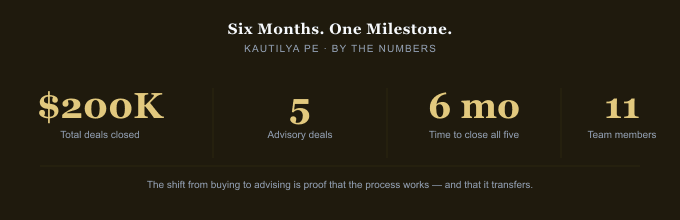
Today? We just closed our 5th advisory deal. $200K total across five completely different acquisitions. Five different businesses we helped someone else buy instead of buying ourselves.
Here’s how that happened (and why it actually makes sense).
The Scoreboard
Let’s start with the receipts. Here’s what we closed:
The Five Deals
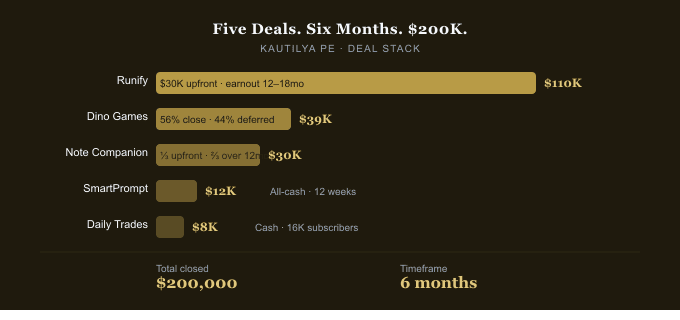
Runify — $110K
Mobile running app. Three months old, ~$2K MRR. Buyer: a 20-year software veteran building a consumer mobile portfolio. Structure: $30K upfront, rest on an earnout tied to revenue stability and retention metrics. Timeline: 45 days from “hey I found this thing” to closed.
Dino Games — $39K
Mobile game making $3K/month profit on $3–4K in ad spend. 40–50% margins. Low maintenance. Found on Reddit at 11 PM on a Tuesday. Structure: 56% at close, 44% deferred over 12 months. Not tied to growth — tied to not falling apart.
Note Companion — $30K
Obsidian plugin making $1,500 MRR with zero effort from the founder — no marketing, nothing. Found through X / Twitter. Structure: 33% upfront, 67% over 12 months.
SmartPrompt — $12K
GPT-native education platform. 2.5M conversations, 30–35 GPTs, 100K+ monthly active users. Buyer: a first-time acquirer with a technical background who basically said “I want to buy something with strong AI-related distribution.” We turned that into an actual acquisition in 12 weeks. Structure: all cash.
Daily Trades Newsletter — $8K
Finance newsletter with 16,000 subscribers. Buyer: operates a finance media roll-up with multiple newsletters and Twitter accounts. Structure: all cash.
Grand total: $200K in deal value closed.
How We Got Here (The Accidental Pivot)
Quick rewind: a year ago, Pocket Fund was me buying micro SaaS businesses, newsletters, and random mobile apps. We bought 7 things. Sold 2 — including Sourcely for low six figures after buying it for $4K. Classic buy-side operator stuff.
We got pretty good at sourcing. Built a machine that threw 30–50 deals at us every week. Most were garbage, but the reps added up.
Then people started asking:
“Yo, how are you finding these deals?”
Then: “Can you help me find deals?”
Then: “I’ll pay you to help me close this.”
And honestly? I thought advisory was lame. Like, why would I help someone else buy a business when I could just buy it myself?
You learn 5x faster when you’re helping other people close deals.
When you’re buying for yourself, you see 1–2 deals a year max (capital constraints). When you’re advising, you see 50+ deals every month. Different buyers. Different risk tolerances. Different structures. It’s like fast-forwarding your deal education.
Plus:
- Better economics — Get paid to learn instead of risking your own money
- Bigger deals — Help clients buy $100K+ businesses you can’t afford yourself
- Network effects — Every client becomes a case study, reference, and potential referral source
So we didn’t stop buying. We just added advisory on top. And it accidentally became the main thing. Team went from 1 (me) to 11 people: analysts, marketing, tech. We opened an office in Bombay. Now we’re helping people close deals we couldn’t dream of doing six months ago.
What Actually Works: 3 Things We Learned
1. Deal Structure Matters Way More Than Purchase Price
Nobody talks about this enough. Buyers obsess over valuation (“Is 3x revenue too much?!”). Sellers obsess over headline numbers (“I want $100K!”).
But the deal that closes? It’s the one with the smart structure.
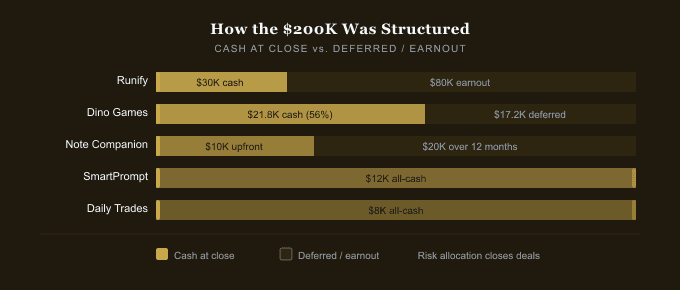
Most deals die over risk allocation, not price. The seller wants certainty. The buyer wants protection. All-cash deals put 100% of the risk on the buyer. That’s why they don’t close — especially on early-stage or volatile assets.
The solution: Creative structures that align incentives.
Runify case study:
- Total consideration: $110K
- Upfront cash: $30K (27%)
- Deferred: $80K (73%) over 12–18 months
- Tied to: Revenue stability and retention metrics (not growth)
Why this worked:
- Seller got their number — Still $110K headline, which matters for their portfolio
- Buyer protected downside — Only risking $30K if the business collapses
- Aligned incentives — Seller sticks around to ensure smooth transition (their payout depends on it)
When you’re looking at deals, don’t just ask “What’s the price?” Ask: how much upfront vs. deferred? What metrics trigger earnout payments? Who bears transition risk?
2. Off-Market Sourcing Is a Cheat Code
Marketplaces (Acquire.com, Flippa, Empire Flippers) are fine. But they’re also where everyone else is looking. Competition = higher prices + worse terms.
The reality: The best deals never hit public marketplaces. Why? Because if you’re a founder with a decent business, you don’t want to list publicly. You don’t want 50 tire-kickers asking for your P&L. You don’t want competitors seeing your numbers. You don’t want your team or customers knowing you’re thinking about selling.
So where do good deals actually happen? Direct relationships.
Method 1: Founder-dense communities
- Runify came from a Twitter thread
- Dino Games came from a Reddit post in r/SideProject
Spend 30 min/day lurking in: Twitter (search for “thinking about selling” “looking to exit” “too busy to maintain”), Reddit (r/SideProject, r/Entrepreneur, niche subreddits for your sector), Indie Hackers forums, and Discord communities relevant to your target sector.
Method 2: Direct outreach to targets
Pick a sector. Build a list. Reach out with a real thesis (not “hey wanna sell?”). Most won’t respond. 5–10% will. That’s enough.
The key insight: off-market doesn’t mean “secret deals nobody knows about.” It means you create the opportunity instead of waiting for someone else to list it.
3. First-Time Buyers Need Decision Frameworks, Not Just Deals
Most people come to us with: “I want to buy a SaaS business.” Cool. What size? What revenue model? What customer segment? What’s your growth thesis? How hands-on will you be? What’s your risk tolerance?
They don’t know. And that’s fine — but without answers to those questions, you can’t filter 50 deals/week. You’ll waste months looking at everything and closing nothing.
Here’s the framework we built for the SmartPrompt buyer:
Stage 1: Non-negotiables (must-haves)
- Price range: $10K–$25K (based on capital available)
- Minimum revenue: $500/month (proof of monetization)
- Must be: AI-related (his domain expertise)
- Must NOT be: high customer support, regulated industry, or hardware
Stage 2: Scoring criteria (nice-to-haves)
- Strong organic traffic (vs. paid-only)
- Tech stack he knows (Python/JS vs. exotic languages)
- Bootstrapped founder (vs. VC-backed with complicated cap table)
- Simple monetization (subscription > ad-based > affiliate)
Stage 3: Red flags (automatic pass)
- Single customer = 50%+ revenue (concentration risk)
- Declining revenue (3+ months down)
- Legal / IP issues
- Seller won’t share traffic or revenue data
Result: we reviewed 50+ deals in 8 weeks. He only looked at 8 that passed the filter. Made offers on 3. Closed 1. Without the framework? He would’ve spent 8 weeks looking at all 50, getting analysis paralysis, and closing zero.
Bonus insight: Most buyers fail because they never commit to criteria. They keep “just looking” at deals forever. The framework forces you to commit. And commitment is what closes deals.
What Didn’t Work (Real Talk)
Let’s be honest: not everything is smooth.
Client expectations vs. reality. Everyone wants a “$10K business making $5K/month with no work required.” Those don’t exist. Or if they do, 50 people are bidding on them. Managing expectations early is the key to not losing clients later.
Deal flow quality. We see 30–50 deals/week. Sounds impressive. Reality? 75%+ are overpriced, declining, or outright fake. The signal-to-noise problem is real. We’re still figuring out how to filter faster without missing the gems.
Team scaling. Going from 1 to 11 people in months is messy. Delegation is hard. Compensation structures are complicated. Quality control is tricky when you’re moving fast. Still figuring it out. But that’s the fun part.
What’s Next
Goal: 5x it. $1M in closed deals by June 2026.
We’re moving upmarket. $10K–$100K deals are cool, but we want to help close $100K–$500K acquisitions. We’re also building out more structured advisory offerings — less one-off deals, more recurring clients.
And yeah, we’re still buying businesses ourselves. Just sold a couple newsletters, looking to exit some old assets. The portfolio strategy isn’t dead — it’s just sharing space with advisory now.
The mission hasn’t changed: make buying a business the “third option” (not just start a company or get a job). We’re just doing it by helping other people buy, not only buying ourselves.
P.S. — If you’re reading this and thinking “I want to do this too,” just start. You don’t need a team of 11 or a fancy process. I started by DMing founders on Twitter and offering to help for free. Six months later, here we are. Reps > theory.